
American century plant (Agave americana)
Agave americana is an evergreen, perennial succulent herb that forms a large basal rosette and can produce basal offshoots that develop into clumps. It is perennial and flowers only once after years of vegetative growth; the main plant then dies, while basal offshoots usually continue growing.
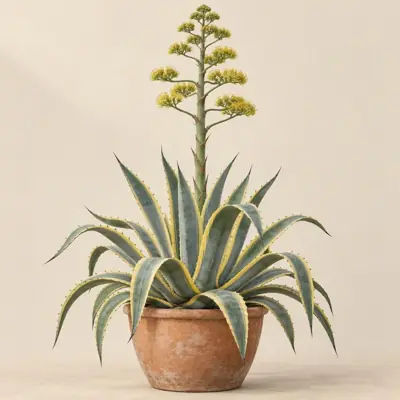
Overview
Agave americana is an evergreen, perennial succulent herb that forms a large basal rosette and can produce basal offshoots that develop into clumps. It is perennial and flowers only once after years of vegetative growth; the main plant then dies, while basal offshoots usually continue growing.
Origin and habitat
Sources differ on its native range: it is mainly described as native to Mexico and the southern United States, with some sources specifically naming Texas and others Arizona and New Mexico. Its original habitat is uncertain; sources describe a possible origin in arid parts of Mexico and the southwestern United States, and it can adapt to dry terrain. It is suited to hot, dry or frost-free climates and is widely cultivated in arid landscapes and regions with Mediterranean-type climates.
Characteristics
Sources differ on mature size, placing its height at about 100–200 cm and its spread at about 180–300 cm. It grows slowly and has thick, succulent, lance-shaped to elongated pointed leaves, usually gray-green, pale gray-green or gray-blue and sometimes variegated, with toothed or hooked-spiny margins and a strong terminal spine; some accounts describe yellow leaf margins. Mature older plants produce a tall, branched panicle from the center of the rosette with yellow to yellow-green flowers, reported to appear in spring; the fruit is reported to be a narrow, three-angled capsule. Agave americana stores water in its leaves.
Light
Agave americana takes full sun and does best there; in containers or indoors it can be kept in a bright location, while some sources indicate that it also tolerates conditions ranging from direct light to more shaded positions.
Watering
Water needs are low to moderate; use a well-drained medium, allow the soil to dry after watering before watering again, reduce water substantially in winter, and avoid prolonged wetness.
Temperature and dormancy
A few sources report a minimum of about -1.1 °C and an ideal range of about 10–12 °C. A USDA hardiness range is reported, and the plant is generally reported to tolerate brief light frost. It rests in winter. It is reported to tolerate heat well, while thrips are reported to occur more readily during hot summer conditions.
Growing medium and mounting
Agave americana needs a fast-draining mix; well-drained sandy or loamy soil can be used, while container plants can use standard cactus growing medium.
Feeding
It can be fertilized during active growth; Agave horticultural guidance describes using slow-release fertilizer or fast-acting liquid fertilizer from spring through autumn, while RHS guidance recommends a balanced liquid fertilizer during the growing period.
Propagation
Agave americana can be propagated by seed or basal offshoots, and horticultural cultivation commonly uses separated offshoots for propagation.
Common problems
Possible pests include agave weevils, scale insects, slugs and snails; general Agave cultivation information also records thrips. Poor drainage or persistently wet soil may lead to root rot, while general Agave cultivation information also records black spot and rust. Large plants occupy considerable space, and the hard spines on the leaf margins and tips can injure people, so placement should account for safe passage. It is suited to dry and hot environments; sources describe limited cold tolerance and widespread cultivation mainly in frost-free climates.
Identification
Agave americana is a large rosette-forming succulent with thick gray-green to gray-blue leaves bearing conspicuous pale-yellow or yellow margins and hard spines along the margins and at the tips; at maturity it flowers only once, producing a huge branched flower stalk that rises far above the foliage.
Photos


Sources
- Wikipedia (en): Agave americana — CC BY-SA 4.0 · link
- 維基百科:龙舌兰 — CC BY-SA 4.0 · link
- Wikipedia (de): Agave americana — CC BY-SA 4.0 · link
- Wikipedia (fr): Agave americana — CC BY-SA 4.0 · link
- Wikipedia (es): Agave americana — CC BY-SA 4.0 · link
- NC State Plant Toolbox: Agave americana — copyright (facts only) · link
- TaiCOL 臺灣物種名錄: Agave americana — CC BY 4.0 · link
- LLIFLE Encyclopedia of living forms: Agave americana — CC BY-SA · link
- Useful Tropical/Temperate Plants: Agave americana — CC BY-NC-SA 3.0 (facts only) · link
- RHS Plants: Agave americana — © RHS, facts only · link
- USDA PLANTS Database: Agave americana — Public domain (US Government work) · link
- NHK みんなの趣味の園芸 植物図鑑: Agave americana — © NHK出版, facts only · link
- Top Tropicals catalog: Agave americana — © Top Tropicals LLC (facts only) · link
- Agave americana f. aureo-marginata | Giromagi cactus and succulents for sale | B (www.giromagi.com) — facts only (§12) · link