
American century plant (Agave americana)
Agave americana is an evergreen, perennial succulent herb that forms a large rosette, with a very short or nearly absent above-ground stem and basal suckers that can form clumps. It is perennial and usually flowers only once after growing for many years; the main plant then dies, while basal offsets generally remain to continue growing.
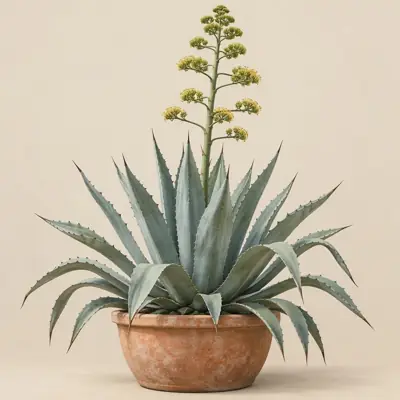
Overview
Agave americana is an evergreen, perennial succulent herb that forms a large rosette, with a very short or nearly absent above-ground stem and basal suckers that can form clumps. It is perennial and usually flowers only once after growing for many years; the main plant then dies, while basal offsets generally remain to continue growing.
Origin and habitat
Sources differ on its North American native range: the core range is described as extending from Mexico to the southern United States, with Texas specifically recorded and some sources also including Arizona and New Mexico. It is associated with arid environments and adapted to dry regions; escaped or naturalized plants also occur in coastal areas, dunes, gravel shores, rocky shores, and scrub. It is suited to dry, hot, or Mediterranean-type climates with relatively little frost, is drought tolerant, and can be cultivated in many frost-free regions worldwide.
Characteristics
Sources differ, but mature plants are reported at about 100–200 cm tall and about 180–400 cm across. Growth is generally reported to be slow, and the plant stores water in its leaves. The thick, succulent leaves are lance-shaped to elongate, gray-green, pale green, or gray-blue, sometimes patterned in cultivated forms, and arranged in a rosette with sharp marginal teeth and a rigid terminal spine. Near the end of its life cycle, a tall, branched panicle emerges from the center of the rosette with mostly yellow to yellow-green flowers; the fruit is reported to be an elongated, three-angled capsule.
Light
Full sun is preferred, and Agave americana takes full sun; container-grown or indoor plants can accept bright light, while some information indicates tolerance from direct sunlight to shadier conditions.
Watering
It is drought tolerant with low water needs; during active growth, water after the growing medium dries, while in winter watering should be greatly reduced and the medium kept relatively dry rather than persistently wet.
Temperature and dormancy
Limited source information reports a minimum of about -1.1 °C, and the plant is generally reported to tolerate brief light frost. It is generally reported for USDA hardiness zones from the warmer end of the scale described by the source, rests in winter, and is reported to have strong heat tolerance.
Growing medium and mounting
Agave americana needs a very fast-draining growing medium, preferably sandy and porous; sandy soil or loam can be used, and a cactus-type mix is suitable for containers.
Feeding
During the growing season it can be fed regularly, with sources describing several schedules using balanced liquid, slow-release, or fast-acting liquid fertilizer.
Propagation
Propagation can be by basal offsets or seed, with offsets separated from the parent plant at an appropriate season and planted separately. Seed is a documented propagation method.
Common problems
Potential pests include agave snout weevils, slugs, snails, scale insects, and thrips. Poor drainage or an overly wet growing medium can lead to root rot, and black spot and rust have also been reported. The large rosette requires ample space, and the sharp leaf margins and tips can cause puncture injuries. It is highly tolerant of drought and heat and has some salt tolerance, making it suited to dry and coastal environments.
Identification
Agave americana forms a large rosette of gray-green to gray-blue succulent leaves with conspicuous spines along the margins and at the tips. Older plants flower only once, producing a huge, heavily branched flower stalk, and commonly produce basal suckers.
Photos


Sources
- Wikipedia (en): Agave americana — CC BY-SA 4.0 · link
- 維基百科:龙舌兰 — CC BY-SA 4.0 · link
- Wikipedia (de): Agave americana — CC BY-SA 4.0 · link
- Wikipedia (fr): Agave americana — CC BY-SA 4.0 · link
- Wikipedia (es): Agave americana — CC BY-SA 4.0 · link
- GBIF descriptions: Manual of the Alien Plants of Belgium; The checklist of alien seed plants of D.R. Congo, based on ev — per dataset · link
- NC State Plant Toolbox: Agave americana — copyright (facts only) · link
- LLIFLE Encyclopedia of living forms: Agave americana — CC BY-SA · link
- Useful Tropical/Temperate Plants: Agave americana — CC BY-NC-SA 3.0 (facts only) · link
- RHS Plants: Agave americana — © RHS, facts only · link
- USDA PLANTS Database: Agave americana — Public domain (US Government work) · link
- NHK みんなの趣味の園芸 植物図鑑: Agave americana — © NHK出版, facts only · link
- Top Tropicals catalog: Agave americana — © Top Tropicals LLC (facts only) · link
- Agave americana | Giromagi cactus and succulents for sale | Buy plants online (www.giromagi.com) — facts only (§12) · link