
lipstickplant (Aeschynanthus radicans)
Aeschynanthus radicans is an evergreen, perennial epiphytic herb with a trailing or vining habit that can also climb and is suitable for hanging containers.
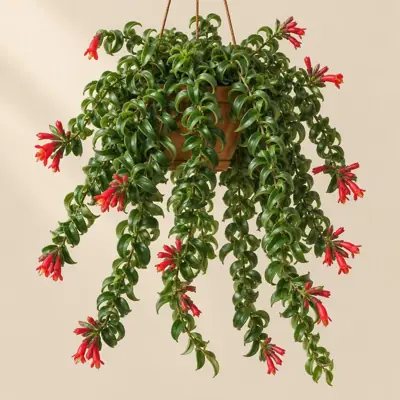
Overview
Aeschynanthus radicans is an evergreen, perennial epiphytic herb with a trailing or vining habit that can also climb and is suitable for hanging containers.
Origin and habitat
Sources differ on its native range, describing it broadly from Thailand to the Malesian region and variously including the Malay Peninsula, Sumatra, Borneo, and areas south to Java. It can grow epiphytically on other plants or on rocks in tropical, humid environments.
Characteristics
Sources differ on mature height, placing it at about 50–100 cm, while a single source reports a mature spread of about 10–50 cm. The evergreen leaves are green and leathery to fleshy, typically ovate to lanceolate and opposite or whorled; the 'Rasta' cultivar has densely curled leaves. The conspicuous tubular flowers are borne at the ends of branches, with upper lobes shorter than the lower ones; they are usually bright red to scarlet, species descriptions also note a yellow throat, and 'Rasta' is specifically described as having bright red flowers.
Light
Provide bright filtered or bright indirect light, avoiding full sun and strong direct sunlight; the conditions can also be described generally as partial shade.
Watering
Water frequently during the growing period while keeping the well-drained growing medium moist but not waterlogged; reduce watering in winter and keep conditions drier.
Temperature and dormancy
A single source reports a minimum temperature of about 10 °C, so sources are few for this figure. It is generally assigned a hardiness rating of H1A.
Growing medium and mounting
Use loam or a peat-free houseplant growing medium that remains moist but drains well; acidic, neutral, and alkaline conditions are all listed as acceptable.
Feeding
Diluted liquid fertilizer can be used during the growing period; the cited sources describe regular diluted feeding as supporting foliage growth and flowering.
Propagation
Propagation is by stem cuttings, including softwood or semi-ripe cuttings, and cut stems are also reported to root in water.
Common problems
Potential pests include aphids, mealybugs, mites, and scale insects. Sources differ on disease issues: one reports grey mould and leaf spot and notes greater fungal-disease risk in humid, stagnant air, while another describes the plant as generally having few diseases. Low temperatures may cause leaf drop, while high humidity without adequate airflow may increase the risk of fungal disease. It prefers warmth, should be protected from low temperatures, and is suited to a sheltered position away from strong direct sunlight.
Identification
The most distinctive features of 'Rasta' are its densely curled leaves, bright red tubular flowers, and trailing, vining appearance suited to hanging containers.
Photos

