
lipstickplant (Aeschynanthus radicans)
Aeschynanthus radicans is an evergreen perennial epiphytic herb with a trailing to pendent habit and may also climb; in natural settings it can grow epiphytically or on rocks.
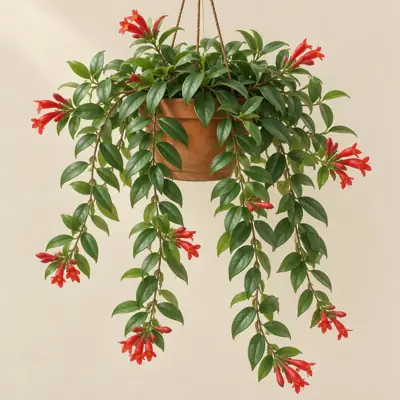
Overview
Aeschynanthus radicans is an evergreen perennial epiphytic herb with a trailing to pendent habit and may also climb; in natural settings it can grow epiphytically or on rocks.
Origin and habitat
Aeschynanthus radicans is native to tropical Southeast Asia, extending approximately from Thailand and the Malay Peninsula to the Malay Archipelago, although sources differ on the specific islands included. It occurs as an epiphyte in tropical forests, including where organic matter accumulates in tree forks, and it may also grow on rocks. It is native to humid tropical regions and prefers warm, highly humid conditions.
Characteristics
Sources differ on mature height, giving a range of about 50–150 cm. A limited source reports a mature spread of about 10–50 cm. The evergreen green leaves are leathery to fleshy, ovate to lanceolate, and may be opposite or whorled; cultivated plants have waxy-looking foliage. The flowers are usually terminal and tubular, with upper lobes shorter than the lower lobes; typical flower color is bright red to scarlet, sometimes with yellow in the throat.
Light
Aeschynanthus radicans favors bright, indirect light to partial shade, with ample light but protection from strong direct sunlight.
Watering
Water regularly during the growing season, keeping the growing medium moist but well drained; reduce watering in winter and avoid prolonged waterlogging.
Humidity and airflow
It is generally reported to prefer high humidity and need moderate airflow.
Temperature and dormancy
A limited source reports a minimum temperature of about 10 °C. Sources differ in their hardiness classifications. It is generally reported to be frost tender and should be kept above freezing.
Growing medium and mounting
Aeschynanthus radicans suits a well-drained growing medium; sources describe loam under moist but well-drained conditions across acidic, neutral, or alkaline pH, and recommend peat-free houseplant potting medium for indoor cultivation.
Feeding
Diluted liquid fertilizer can be applied during the growing season, with feeding described from mid-spring through late summer.
Propagation
Aeschynanthus radicans can be propagated from stem cuttings, including softwood cuttings in spring and semi-ripe cuttings in summer. Soft stem cuttings can root in a moist vermiculite-and-perlite medium, while another source reports that cut stems can first be rooted in water.
Common problems
Possible pests include aphids, mealybugs, scale insects, and mites. Sources differ in their descriptions of disease problems, which may include grey mould and leaf spot; humid, stagnant air may increase the risk of fungal disease. Low temperatures are reported to cause leaf drop, while high humidity combined with poor airflow may promote fungal disease. The plant does not tolerate frost or low temperatures and is best kept in a sheltered, protected position and protected from freezing.
Identification
Bright red tubular flowers emerging from slender buds resemble lipstick, while the plant has a trailing or pendent habit suited to hanging containers; some sources also describe a relatively strong odor.
Photos


Sources
- Wikipedia (en): Aeschynanthus radicans — CC BY-SA 4.0 · link
- Wikipedia (es): Aeschynanthus radicans — CC BY-SA 4.0 · link
- NC State Plant Toolbox: Aeschynanthus radicans — copyright (facts only) · link
- RHS Plants: Aeschynanthus radicans — © RHS, facts only · link
- Top Tropicals catalog: Aeschynanthus radicans — © Top Tropicals LLC (facts only) · link