
Haworth's aeonium (Aeonium haworthii)
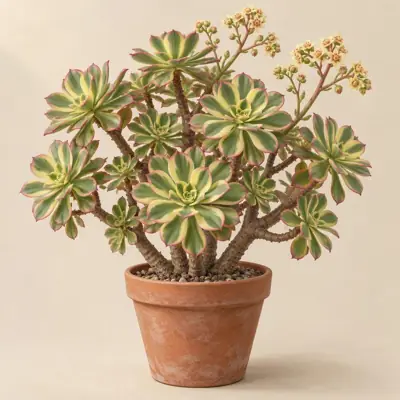
Aeonium haworthii is an evergreen, perennial, much-branched shrubby succulent with rosettes at the ends of its branches.
Overview
Aeonium haworthii is an evergreen, perennial, much-branched shrubby succulent with rosettes at the ends of its branches.
Origin and habitat
Sources differ on its native range: Tenerife in the Canary Islands is specifically recorded, while broader accounts describe Macaronesia or the Canary Islands and North Africa. It is recorded from sandy coastal habitat, with another record from an elevated locality on Tenerife. It is adapted to mild, relatively dry conditions and grows in winter, with growth weakening or entering dormancy during hot summers.
Characteristics
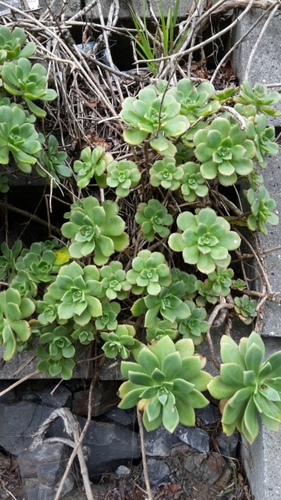
Sources differ on mature height, placing it at about 40–90 cm, while mature spread is 10–50 cm. Its fleshy, water-storing leaves form terminal rosettes; they are obovate to broader, nearly hairless, gray-green, green, or yellow-green, sometimes with a pronounced blue-gray tone, and have curved marginal cilia that are often red. It forms loose paniculate or cymose inflorescences with small flowers ranging from pale yellow or creamy white to flowers marked with pink or red lines, and flowering is recorded in spring. The fruit is generally reported to be small and papery and to split open when mature.
Light
Aeonium haworthii takes full sun and can grow in bright conditions; ample light helps maintain vivid leaf color, while in hot summers it benefits from shade or moderate shading with good ventilation.
Watering
Sources differ on watering guidance, but describe thorough watering during winter growth after the surface of the growing medium dries, with greatly reduced watering and drier conditions during summer dormancy; prolonged wetness and extended rain should be avoided.
Humidity and airflow
It is reported to need good airflow.
Temperature and dormancy
Sources differ on the lower temperature limit, placing it at about -4 °C, and a separate single-source account likewise reports about -4 °C as a cold minimum; it is also reported to tolerate brief light frost. A single source reports an ideal temperature range, while sources give differing USDA hardiness-zone ratings. Aeonium haworthii rests in summer and is less tolerant of hot summer conditions, when a shaded, well-ventilated environment is recommended.
Growing medium and mounting
It grows in well-drained sandy or loamy media, including potting mixes for cacti and succulents, and the soil may range from acidic to alkaline. It needs a fast-draining mix.
Feeding
Feed lightly during growth, using either slow-release fertilizer or liquid fertilizer; balanced liquid fertilizer is also recommended at regular intervals during growth.
Propagation
Aeonium haworthii can be propagated by rosette or stem cuttings and by seed, while genus-level information also describes division of clumping plants.
Common problems
Potential pests include aphids, scale insects or mealybugs, and root scale insects, while major disease problems are generally not prominent. Commonly noted risks include aphids, mealybugs, and damage from cold frost. It does not favor extremely cold conditions and is also sensitive to hot summers; protection from cold and a cool, shaded, well-ventilated location during summer heat are recommended.
Identification
Aeonium haworthii can be distinguished by rosettes of flat, fleshy leaves at the ends of woody branches; the nearly hairless leaves are gray-green to yellow-green, with ciliate margins that are often edged in red.
Photos


Sources
- GBIF Backbone: Aeonium haworthii Salm-Dyck ex Webb & Berthel. — CC BY 4.0 · link
- Wikipedia (en): Aeonium haworthii — CC BY-SA 4.0 · link
- Wikipedia (de): Aeonium haworthii — CC BY-SA 4.0 · link
- Wikipedia (fr): Aeonium haworthii — CC BY-SA 4.0 · link
- Wikipedia (es): Aeonium haworthii — CC BY-SA 4.0 · link
- RHS Plants: Aeonium haworthii — © RHS, facts only · link
- USDA PLANTS Database: Aeonium haworthii — Public domain (US Government work) · link
- Desert-Tropicals: Aeonium haworthii — © Philippe Faucon (desert-tropicals.com), facts only · link
- The Succulent Plant Page: Aeonium (genus-level) — © R.J. Hodgkiss, facts only · link
- NHK みんなの趣味の園芸 植物図鑑: Aeonium (genus-level) — © NHK出版, facts only · link
- NC State Plant Toolbox: Aeonium (genus-level) — copyright (facts only) · link
- Aeonium haworthii 'Kiwi' | Giromagi cactus and succulents for sale | Buy plants (www.giromagi.com) — facts only (§12) · link
- PUKUBOOK: Aeonium haworthii — CC BY-NC (facts only) · link