
Amazonian Zebra-plant (Aechmea chantinii)
Aechmea chantinii is an evergreen herbaceous perennial that usually forms an upright funnel- or vase-shaped rosette and grows as an epiphyte in its native habitat. Each rosette flowers once and then the mother plant dies, while basal offsets continue the plant's growth.
Overview
Aechmea chantinii is an evergreen herbaceous perennial that usually forms an upright funnel- or vase-shaped rosette and grows as an epiphyte in its native habitat. Each rosette flowers once and then the mother plant dies, while basal offsets continue the plant's growth.
Origin and habitat
Sources differ on its native range, describing tropical South America, including Brazil, Venezuela, Colombia, Ecuador, and Peru, with a principal association with the Amazon region. It occurs in Amazon rainforest and other tropical South American forest environments and can grow epiphytically on tree trunks and branches; Colombian records include the Andes, Guiana, and Serranía de La Macarena biogeographic regions. It is reported to favor warm tropical conditions and not tolerate frost.
Characteristics
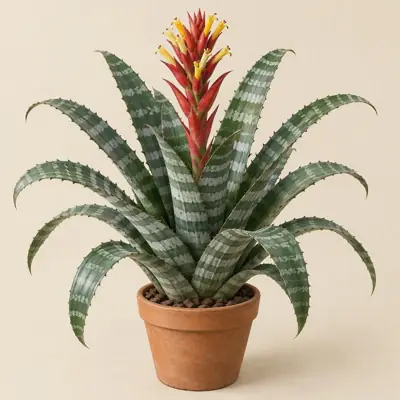
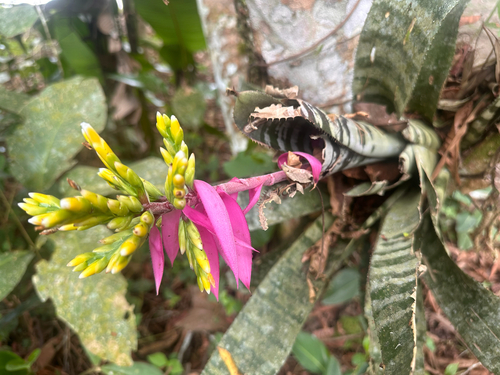
Sources differ on mature height, placing it at about 50–100 cm, while mature spread is 50–100 cm. The stiff, leathery, fleshy leaves form a rosette and range from strap-shaped to elliptical; they are dark green to olive green with conspicuous silvery-gray or pale transverse bands, with some descriptions also noting longitudinal stripes, numerous small marginal spines, and potentially red leaf bases. The inflorescence emerges from the center of the rosette with conspicuous red to orange-red bracts and tubular flowers that are mainly yellow and red, and it remains ornamental for a period; flowering is generally reported in summer. The fruit is reported to be a berry that may be blue or white.
Light
Aechmea chantinii does well in bright filtered or bright indirect light, while full sun to partial shade is also listed as acceptable.
Watering
Water after the surface of the growing medium has dried, and fill the central tank, through which the plant can absorb and store water; in high temperatures and strong light, keeping water in the tank is more important. Rainwater or distilled water is recommended to reduce salt accumulation, and the central tank should be emptied and flushed regularly. Staying moist is fine.
Temperature and dormancy
Few sources report a cold minimum of about 15.6 °C.
Growing medium and mounting
Use a fast-draining or well-drained epiphytic bromeliad growing medium; loam and sandy soil are also listed, while moist, coarse, humus-rich soil is listed for outdoor growing, with acidic, neutral, and alkaline conditions all described as acceptable.
Feeding
Low-nitrogen fertilizer is generally applied during the growing season.
Propagation
Propagate from basal offsets, separating and potting them once they have reached a suitable size relative to the mother plant; rooting offsets in early summer is also recommended.
Common problems
Mealybugs, scale insects, and spider mites can be pests, while diseases are generally uncommon and overwatering can cause root rot. It is reported that salts from water can accumulate and harm the plant, and leaving the central tank uncleaned for long periods may increase pest problems. It is reported to be frost-tender and to require moving indoors during winter in cold regions.
Identification
Aechmea chantinii can be recognized by its vase-shaped rosette with a central water-holding tank, dark green to olive green leaves with prominent silvery-gray or pale transverse bands, red to orange-red bracts, and yellow-and-red flowers.
Photos


Sources
- Wikipedia (en): Aechmea chantinii — CC BY-SA 4.0 · link
- Wikipedia (fr): Aechmea chantinii — CC BY-SA 4.0 · link
- Wikipedia (es): Aechmea chantinii — CC BY-SA 4.0 · link
- GBIF descriptions: Catálogo de Plantas y Líquenes de Colombia — per dataset · link
- NC State Plant Toolbox: Aechmea chantinii — copyright (facts only) · link
- RHS Plants: Aechmea chantinii — © RHS, facts only · link
- NHK みんなの趣味の園芸 植物図鑑: Aechmea (genus-level) — © NHK出版, facts only · link