
delta maidenhair (Adiantum raddianum)
Adiantum raddianum is a perennial, clumping herbaceous fern with a short to spreading rhizome from which it can expand. It is reported to be terrestrial.

Overview
Adiantum raddianum is a perennial, clumping herbaceous fern with a short to spreading rhizome from which it can expand. It is reported to be terrestrial.
Origin and habitat
Sources differ on its native range, describing it as native from tropical America into South America, with some accounts explicitly including the West Indies. In the wild, it is reported from forest floors, rock crevices, riverbanks, coastal cliffs, and basaltic banks beside trails or streams. It is primarily native to tropical American environments and is considered tender in horticulture.
Characteristics
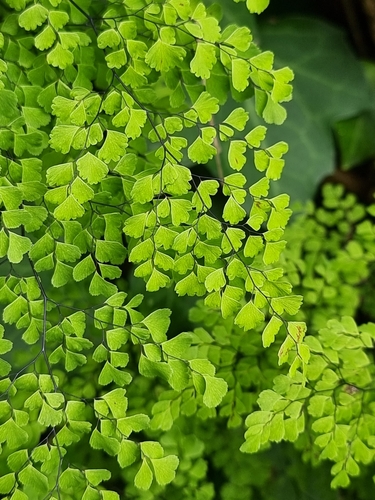
Sources differ on mature size, placing both height and spread at about 30–60 cm. The multiply pinnate fronds are triangular to elongated-triangular overall, with pinnules that are commonly fan-shaped, triangular, or rounded and may be lobed; the slender stipes and rachises are black, while young fronds are paler green and darken as they mature. The plant has a creeping rhizome.
Light
It grows in bright indirect light to partial shade; full sun and prolonged excessively dark conditions should be avoided.
Watering
Keep the growing medium evenly moist to wet but well drained, avoiding complete drying of the roots and reducing watering in winter.
Humidity and airflow
Adiantum raddianum has a high humidity need.
Temperature and dormancy
A single source reports a minimum tolerance or overwintering temperature of around 5 °C. A USDA hardiness classification is reported by a single source. The fern is tender.
Growing medium and mounting
Use a moist but well-drained growing medium; neutral to slightly alkaline soil is preferred, with loam specified as an option and peat-free houseplant potting mix suitable for indoor cultivation.
Feeding
A single source recommends applying a diluted general liquid fertilizer from mid-spring through late summer.
Propagation
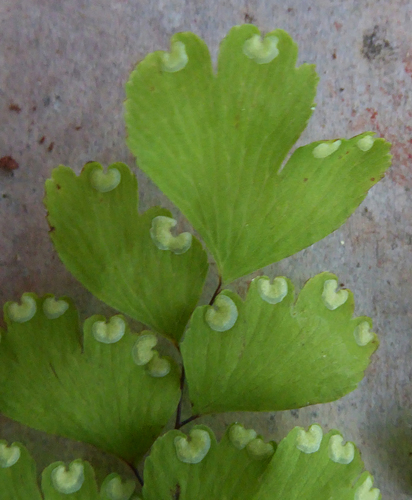
It is reported that mature spores can be sown immediately, and propagation can also be carried out by dividing the rhizome in early spring. The spores are reported to occur beneath reflexed marginal flaps and can be sown immediately when mature. Division is another propagation method, including rhizome division in early spring.
Common problems
Sources differ on reported pests, which include scale insects and mealybugs, while another account also reports Florida fern caterpillar as potentially damaging. No significant disease problems are generally reported. A single source reports that excessive sun can cause scorching, excessive shade can reduce plant vigor, and the roots should not dry out completely. A single source reports sensitivity to low temperatures and describes indoor overwintering in temperate regions, with a sheltered outdoor position in summer.
Identification
Adiantum raddianum is distinguished by slender, glossy black stipes and rachises with fan-shaped to triangular pinnules; the sori occur along the leaf margins and are covered by false indusia formed from reflexed margins.
Photos


Sources
- Wikipedia (en): Adiantum raddianum — CC BY-SA 4.0 · link
- Wikipedia (ja): コバホウライシダ — CC BY-SA 4.0 · link
- GBIF descriptions: Manual of the Alien Plants of Belgium; Catálogo de Plantas y Líquenes de Colombia; DAISIE - Inventor — per dataset · link
- NC State Plant Toolbox: Adiantum raddianum — copyright (facts only) · link
- Wikipedia (nl): Fijn venushaar — CC BY-SA 4.0 · link
- RHS Plants: Adiantum raddianum — © RHS, facts only · link
- USDA PLANTS Database: Adiantum raddianum — Public domain (US Government work) · link
- 臺北典藏植物園 植物資料庫: Adiantum raddianum — © 臺北典藏植物園, facts only · link
- NHK みんなの趣味の園芸 植物図鑑: Adiantum raddianum — © NHK出版, facts only · link