
common maidenhair (Adiantum capillus-veneris)
Adiantum capillus-veneris is a perennial lithophytic fern with short to creeping rhizomes that can form spreading clumps.
Overview
Adiantum capillus-veneris is a perennial lithophytic fern with short to creeping rhizomes that can form spreading clumps.
Origin and habitat
Sources differ on its native range, describing it broadly across warm-temperate to tropical regions, including western and southern Europe, Africa, Asia, Australasia, and many parts of the Americas; it is described as native but not endemic to Taiwan. It commonly grows in moist, shaded, well-drained settings such as rock faces, rock crevices, limestone areas, near streams and springs, caves, and canyons, and also occurs in forests and other moist habitats. It is associated with warm, humid climates from warm-temperate to tropical regions.
Characteristics
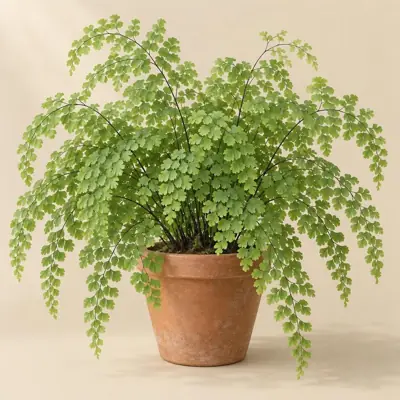
Sources differ on mature height, placing it at about 10–50 cm; the few available sources report a mature spread of about 10–50 cm. Sources differ in describing its growth rate as slow to moderate. The delicate, thin fronds are pale green to green and typically divided repeatedly, with fan-shaped, obliquely fan-shaped, or nearly diamond-shaped pinnules with lobed margins and slender, glossy, purple-black to black stalks and axes. It has a creeping rhizome.
Light
Sources differ somewhat on light: partial to full shade with bright, indirect light is described as suitable, with strong direct sunlight avoided, while some sources indicate that stronger light may be tolerated under suitable conditions such as high humidity. It tolerates shade.
Watering
Keep the growing medium evenly moist but not waterlogged or saturated, while maintaining ample environmental moisture.
Humidity and airflow
It prefers high humidity and has a high humidity need.
Temperature and dormancy
The few available sources report a minimum temperature of about 12 °C. It is generally rated RHS H3 and described as tender.
Growing medium and mounting
It grows in moist but well-drained media rich in humus or organic matter and can grow in sandy, loamy, clay, or chalky soils, with a preference for neutral to alkaline conditions and a high tolerance of calcium carbonate.
Feeding
Potted plants are reported to require feeding.
Propagation
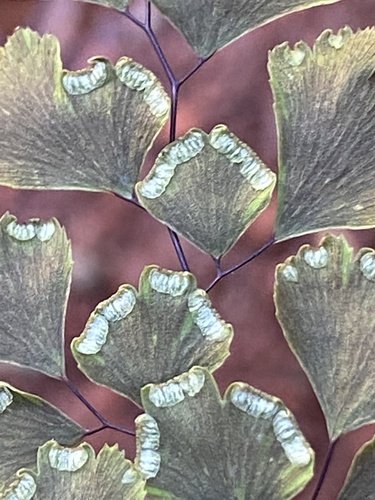
It can be propagated by division or spores, with each division retaining a section of rhizome. Sori occur along the frond margins or in shallow notches associated with the fan-shaped veins, and spores can be used for propagation.
Common problems
Sources differ on pests: the Florida fern caterpillar may occur, while it is also described as generally having no significant pest problems. It is generally reported to have no significant disease problems. Strong sunlight may cause sun scorch, and dry conditions are unsuitable; it does not tolerate drought or strong direct sunlight and prefers protected, moist conditions.
Identification
Adiantum capillus-veneris has slender, black, wiry frond stalks and axes, with fan-shaped to obliquely fan-shaped pinnules arranged in a flat plane; sori occur along the pinnule margins and are covered by the reflexed leaf margins.
Photos


Sources
- Wikipedia (en): Adiantum capillus-veneris — CC BY-SA 4.0 · link
- 維基百科:鐵線蕨 — CC BY-SA 4.0 · link
- Wikipedia (ja): ホウライシダ — CC BY-SA 4.0 · link
- Wikipedia (de): Gewöhnlicher Frauenhaarfarn — CC BY-SA 4.0 · link
- Wikipedia (fr): Capillaire de Montpellier — CC BY-SA 4.0 · link
- Wikipedia (es): Adiantum capillus-veneris — CC BY-SA 4.0 · link
- GBIF descriptions: Manual of the Alien Plants of Belgium; Database of Vascular Plants of Canada (VASCAN); DAISIE - Inve — per dataset · link
- NC State Plant Toolbox: Adiantum capillus-veneris — copyright (facts only) · link
- TaiCOL 臺灣物種名錄: Adiantum capillus-veneris — CC BY 4.0 · link
- Useful Tropical/Temperate Plants: Adiantum capillus-veneris — CC BY-NC-SA 3.0 (facts only) · link
- RHS Plants: Adiantum capillus-veneris — © RHS, facts only · link
- USDA PLANTS Database: Adiantum capillus-veneris — Public domain (US Government work) · link
- 臺北典藏植物園 植物資料庫: Adiantum capillus-veneris — © 臺北典藏植物園, facts only · link
- NHK みんなの趣味の園芸 植物図鑑: Adiantum (genus-level) — © NHK出版, facts only · link