
Adenia globosa (Adenia globosa)
Adenia globosa is a dioecious, succulent, deciduous shrub or climber whose branches may grow upright, climb, or trail.
Overview
Adenia globosa is a dioecious, succulent, deciduous shrub or climber whose branches may grow upright, climb, or trail.
Origin and habitat
Sources differ on its native range, which is described as tropical East Africa, including Ethiopia, Kenya, Somalia, and Tanzania. It occurs in dry scrub, bushland savanna, dry woodland, deciduous scrub, Acacia-Commiphora scrub, and dry evergreen scrub. Its climate is tropical, dry, and warm; natural habitats can be very hot and dry, while cultivation should avoid frost and prolonged cold.
Characteristics
Sources differ on mature dimensions, with height reported at about 200–800 cm and spread at about 200–250 cm. It has a swollen stem, and its branches can become long while the swollen stem can become very broad in its native habitat; growth is reported to be good but very slow, with moderate water, warmth, and fertilizer during active growth reported to increase its growth rate. The small, gray-green, deciduous leaves are alternate and may be triangular, shallowly lobed, rhombic, or hastate, with entire margins and a reniform gland at the leaf base; the green leathery capsules are smooth and range from spherical to ovoid or ellipsoid. Sources differ in descriptions of the flowers; the plant is dioecious, and its flowers are usually greenish white, borne singly or in axillary cymes, with male flowers bearing stamens and female flowers bearing styles.
Light
Give full sun to bright partial sun; the leaves prefer sun, while the caudex should be shaded and protected from intense direct exposure in summer.
Watering
Water regularly during the growing season without keeping the growing medium persistently wet; reduce watering markedly in winter and during leafless dormancy, keep it drier, and water sparingly while leafless because excessive moisture can lead to rot.
Temperature and dormancy
Sources differ on the minimum temperature, placing it at about 7 °C, while another supported claim gives a cold minimum of 7 °C. It is frost tender; keep above freezing, and it drops its leaves and goes dormant. It is reported to have high heat tolerance. It is generally reported for warm USDA hardiness zones.
Growing medium and mounting
It needs a very loose, porous, very fast-draining growing medium that may include pumice, volcanic rock, and perlite, and it performs better in acidic soil.
Feeding
Moderate feeding during active growth is reported to help increase growth rate when combined with adequate water and warmth.
Propagation
Sources differ on propagation details, but seed and cuttings are described as propagation methods; plants grown for an ornamental caudex are preferably raised from seed because cuttings usually do not form the typical caudex.
Common problems
Insufficient light can cause elongated growth, overly intense sun can scorch the swollen stem, excess water can cause rot, and long spines can cause puncture injuries. It does not tolerate frost or prolonged cold, and winter conditions are better kept warmer and dry. Excessive moisture in the growing medium or during the leafless period is reported to make rot more likely.
Identification
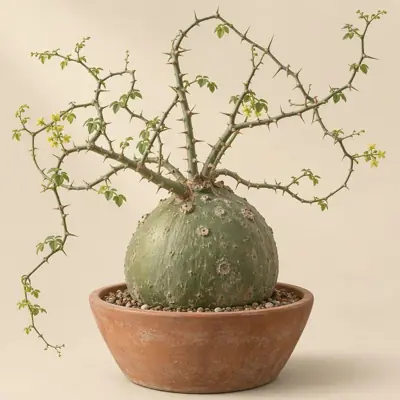
The most conspicuous features are a large, green, warty, nearly spherical swollen caudex or stem base and the dense, twisted, spiny branches emerging from it; the spines can be long, and wild plants can develop a very broad caudex.
Photos


Sources
- Wikipedia (en): Adenia globosa — CC BY-SA 4.0 · link
- Wikipedia (ja): アデニア・グロボーサ — CC BY-SA 4.0 · link
- LLIFLE Encyclopedia of living forms: Adenia globosa — CC BY-SA · link
- Useful Tropical/Temperate Plants: Adenia globosa — CC BY-NC-SA 3.0 (facts only) · link
- Desert-Tropicals: Adenia globosa — © Philippe Faucon (desert-tropicals.com), facts only · link
- The Succulent Plant Page: Adenia (genus-level) — © R.J. Hodgkiss, facts only · link
- Adenia globosa | Giromagi cactus and succulents for sale | Buy plants online (www.giromagi.com) — facts only (§12) · link
- PUKUBOOK: Adenia globosa — CC BY-NC (facts only) · link