
grassleaf sweet flag (Acorus gramineus)
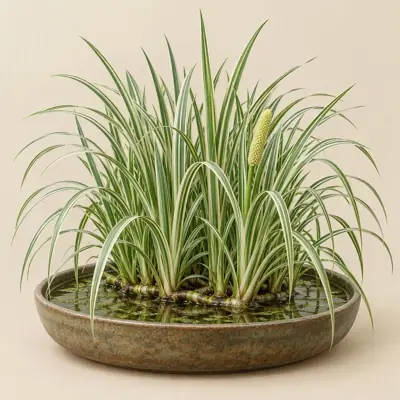
Acorus gramineus is a clump-forming herbaceous aquatic to wetland plant with creeping, branching rhizomes that can form ground-covering colonies; this selection has variegated foliage. It is a perennial herb that can be evergreen in tropical regions, while RHS describes it as semi-evergreen.
Overview
Acorus gramineus is a clump-forming herbaceous aquatic to wetland plant with creeping, branching rhizomes that can form ground-covering colonies; this selection has variegated foliage. It is a perennial herb that can be evergreen in tropical regions, while RHS describes it as semi-evergreen.
Origin and habitat
Sources differ on its native range; it is native to Asia, primarily from the eastern Himalayas and East Asia through Southeast Asia, including China, Japan, Korea, northeastern India, parts of Indochina, and the Philippines, while Taiwan's species checklist also lists it as native to Taiwan. It occurs in wetlands, shallow water, around ponds and streams, on moist rocky stream banks, in mountain streams and among gravel in running water, as well as in moist woodland and grassland; some populations grow emergent. Its distribution spans temperate, subtropical, and tropical Asia, and it is adapted to persistently wet to shallow-water environments.
Characteristics
Sources differ on mature height, placing it at about 10–50 cm, while the few sources for mature spread report about 10–50 cm. It spreads outward by rhizomes to form ground cover, but sources differ on growth rate, describing it either as capable of active expansion or as forming dense clumps that spread slowly. Sources differ somewhat in their descriptions of the narrow, elongated, linear to sword-shaped leaves, which are arranged in clumps or rows; the longer leaves of this selection have yellow stripes. The small, bisexual flowers are densely arranged on a spadix and range from pale yellow and yellow-green to somewhat whitish, with little ornamental prominence; flowering is mainly from spring to early summer, and berries containing several seeds can form.
Light
It grows in full sun to partial shade; in regions with hot summers, afternoon shade is more suitable.
Watering
It prefers shallow water or a very wet, poorly drained medium that does not dry out, and it can be partly submerged; some sources also indicate that it can be grown fully submerged. Dry soil may cause leaf scorch.
Temperature and dormancy
RHS generally reports its hardiness as H6.
Growing medium and mounting
It suits persistently wet or poorly drained soils; RHS lists clay, loam, and chalky soils and accepts acidic, neutral, or alkaline conditions.
Propagation
It is reported to be propagated by dividing the fleshy rhizomes and establishing the bases of the divisions in shallow water.
Common problems
It is generally reported to have no significant pest or disease problems, although an overly dry growing medium may cause leaf scorch. In regions with hot summers, it is generally advisable to avoid overly strong afternoon sun and provide afternoon shade.
Identification
Slender, grass-like leaves grow in clumps from aromatic creeping rhizomes; 'Variegatus' is distinguished by yellow longitudinal stripes on the leaves.
Photos


Sources
- Wikipedia (en): Acorus gramineus — CC BY-SA 4.0 · link
- 維基百科:石菖蒲 — CC BY-SA 4.0 · link
- Wikipedia (ja): セキショウ — CC BY-SA 4.0 · link
- Wikipedia (de): Schmalblättriger Kalmus — CC BY-SA 4.0 · link
- Wikipedia (fr): Acorus gramineus — CC BY-SA 4.0 · link
- Wikipedia (es): Acorus gramineus — CC BY-SA 4.0 · link
- GBIF descriptions: An updated checklist of aquatic plants of Myanmar and Thailand; DAISIE - Inventory of alien invasive — per dataset · link
- NC State Plant Toolbox: Acorus gramineus — copyright (facts only) · link
- TaiCOL 臺灣物種名錄: Acorus gramineus — CC BY 4.0 · link
- Useful Tropical/Temperate Plants: Acorus gramineus — CC BY-NC-SA 3.0 (facts only) · link
- RHS Plants: Acorus gramineus — © RHS, facts only · link