
triangle cactus (Acanthocereus tetragonus)
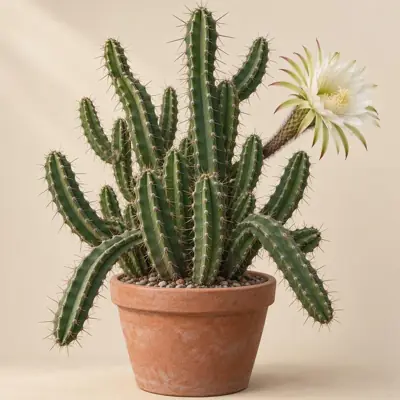
Sources describe Acanthocereus tetragonus differently as a spiny, essentially leafless cactus with columnar to leaning or climbing growth, which may be shrubby or trailing and often forms multi-stemmed thickets. It is reported to be perennial.
Overview
Sources describe Acanthocereus tetragonus differently as a spiny, essentially leafless cactus with columnar to leaning or climbing growth, which may be shrubby or trailing and often forms multi-stemmed thickets. It is reported to be perennial.
Origin and habitat
The native range extends from Florida and southern Texas through Mexico, Central America, and the Caribbean to northern South America, with multiple sources explicitly including Venezuela. Sources differ in describing its habitats, which include coastal scrub, coastal woodland, sandy coastal environments, dry forest, low secondary scrub, pastures, and roadsides, with some records also from wetter forests. It is adapted to arid tropical to subtropical environments and can cope with water scarcity and high temperatures.
Characteristics
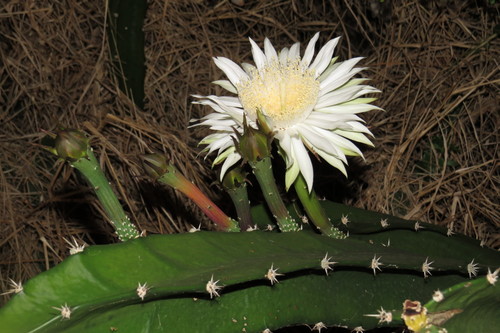
Sources differ on mature height, with the few reported figures placing it at about 200–700 cm. Sources differ in their descriptions of the large, night-opening flowers: the perianth is mainly white, greenish white, or pale green, with some accounts describing creamy white, purplish-cream, or reddish-orange tones toward the center or interior. It can flower several times during the year; another source records flowering in late summer, with flowers opening at night. Sources differ in describing the mature fruit as red to purplish red and ovoid to elongated, while the plant has no conspicuous leaf blades.
Light
Sources differ on light conditions, ranging from full sun to bright light, partial sun, or shade; outdoor cultivation information for well-drained conditions tends toward ample sun, while some horticultural sources recommend bright light or light shade. It takes full sun.
Watering
Acanthocereus tetragonus suits well-drained conditions and can adapt to water scarcity.
Temperature and dormancy
Sources differ on the minimum temperature, with the few reported figures placing it at about -4 °C. Sources differ on its reported USDA hardiness zone. It is reported to tolerate brief light frost and to be frost hardy. A single source reports a cold minimum of about -4 °C, so sources are few.
Growing medium and mounting
It is reported to prefer sandy, well-drained soil with little humus. It is generally reported to need a fast-draining mix.
Propagation
Acanthocereus tetragonus can be propagated by cuttings or seed.
Common problems
It is reported to have strong spines and, in suitable environments, to form dense, spiny thickets that are difficult to pass through; it is regarded as invasive in New Caledonia. Sources differ markedly on cold tolerance, with one account describing substantial cold tolerance while another horticultural source describes sensitivity to frost and freezing.
Identification
The stems are usually dark green, ribbed, often arching, and able to root where they contact the ground; they have conspicuous areoles and numerous spines, and large plants can form thickets that are difficult to pass through.
Photos



Sources
- GBIF Backbone: Acanthocereus tetragonus (L.) Hummelinck — CC BY 4.0 · link
- Wikipedia (en): Acanthocereus tetragonus — CC BY-SA 4.0 · link
- 維基百科:连城角 — CC BY-SA 4.0 · link
- Wikipedia (de): Acanthocereus tetragonus — CC BY-SA 4.0 · link
- Wikipedia (fr): Acanthocereus tetragonus — CC BY-SA 4.0 · link
- Wikipedia (es): Acanthocereus tetragonus — CC BY-SA 4.0 · link
- GBIF descriptions: Catálogo de Plantas y Líquenes de Colombia; Lista comentada de las plantas vasculares de bosques sec — per dataset · link
- Useful Tropical/Temperate Plants: Acanthocereus tetragonus — CC BY-NC-SA 3.0 (facts only) · link
- USDA PLANTS Database: Acanthocereus tetragonus — Public domain (US Government work) · link
- Desert-Tropicals: Acanthocereus tetragonus — © Philippe Faucon (desert-tropicals.com), facts only · link
- Top Tropicals catalog: Acanthocereus tetragonus — © Top Tropicals LLC (facts only) · link
- PUKUBOOK: Acanthocereus tetragonus — CC BY-NC (facts only) · link