
okra (Abelmoschus esculentus)
Abelmoschus esculentus is an upright herb to semi-shrubby plant that is often branched, with hairs sometimes present on the plant, leaves, and fruits. It is described as annual or perennial, being perennial in tropical regions but usually cultivated as an annual in temperate regions; sources describe its life cycle differently.
Overview
Abelmoschus esculentus is an upright herb to semi-shrubby plant that is often branched, with hairs sometimes present on the plant, leaves, and fruits. It is described as annual or perennial, being perennial in tropical regions but usually cultivated as an annual in temperate regions; sources describe its life cycle differently.
Origin and habitat
Its native origin is disputed; the combined sources more strongly support Africa, particularly eastern and northeastern Africa through western Africa and the Sahel, while some sources indicate tropical Asian or South Asian origins. Its original habitat in a truly wild state is unknown, and it is now widely cultivated and can become naturalized in some regions. It is suited to warm tropical, subtropical, and warm-temperate environments, favoring warmth and sunlight, and many cultivars are adapted to humid tropical lowlands.
Characteristics
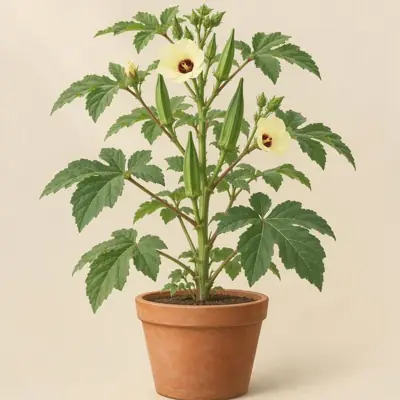
Sources differ, but mature height is reported at about 150–300 cm; with few sources, mature spread is reported at about 100–150 cm. It is reported to grow rapidly in warm conditions. The leaves are large and palmately lobed, with toothed or notched margins and sometimes stiff hairs; solitary axillary flowers have white to pale-yellow petals, often with red, reddish-purple, or purple markings at their bases, and flowering occurs in summer. The fruit is an upright, elongated, pointed capsule, usually green but red, reddish-purple, or yellow in some cultivars, and its cross-section is often angular or ridged.
Light
It prefers full sun in a warm, sunny position sheltered from strong winds.
Watering
It prefers soil that retains moisture while draining well and is suited to moist, humus-rich soil.
Humidity and airflow
It is generally reported to prefer high humidity and need little air movement.
Temperature and dormancy
Sources differ on the lower temperature value, which is reported at about 12 °C. With few sources, the upper temperature value is reported at about 35 °C.
Growing medium and mounting
It prefers well-drained, humus-rich, fertile soil and can adapt to clay, loam, and sandy soils; it prefers a particular soil reaction while tolerating a broader range.
Propagation
It is propagated by seed and can be sown or planted out after the risk of frost has passed; in temperate regions, seedlings can also be started indoors.
Common problems
Potential pests include aphids, nematodes, slugs, snails, glasshouse red spider mites, and glasshouse whiteflies, while deer may browse the leaves. It is reported to be susceptible to powdery mildew. Fine hairs on the pods can cause skin itching or irritation. It is cold-sensitive and susceptible to frost; low temperatures suppress growth, and cold spells can severely affect yield.
Identification
Distinguishing features include large palmately lobed leaves, pale-yellow mallow-like flowers with reddish-purple centers, and upward-growing, ridged capsules with short hairs.
Photos


Sources
- Wikipedia (en): Okra — CC BY-SA 4.0 · link
- 維基百科:秋葵 — CC BY-SA 4.0 · link
- Wikipedia (ja): オクラ — CC BY-SA 4.0 · link
- Wikipedia (de): Okra — CC BY-SA 4.0 · link
- Wikipedia (fr): Gombo — CC BY-SA 4.0 · link
- Wikipedia (es): Abelmoschus esculentus — CC BY-SA 4.0 · link
- GBIF descriptions: The checklist of alien seed plants of D.R. Congo, based on evidence from herbarium collections; Chec — per dataset · link
- NC State Plant Toolbox: Abelmoschus esculentus — copyright (facts only) · link
- TaiCOL 臺灣物種名錄: Abelmoschus esculentus — CC BY 4.0 · link
- Useful Tropical/Temperate Plants: Abelmoschus esculentus — CC BY-NC-SA 3.0 (facts only) · link
- RHS Plants: Abelmoschus esculentus — © RHS, facts only · link
- USDA PLANTS Database: Abelmoschus esculentus — Public domain (US Government work) · link